May 19, 2026 — Essay #160
Complicity as Composition
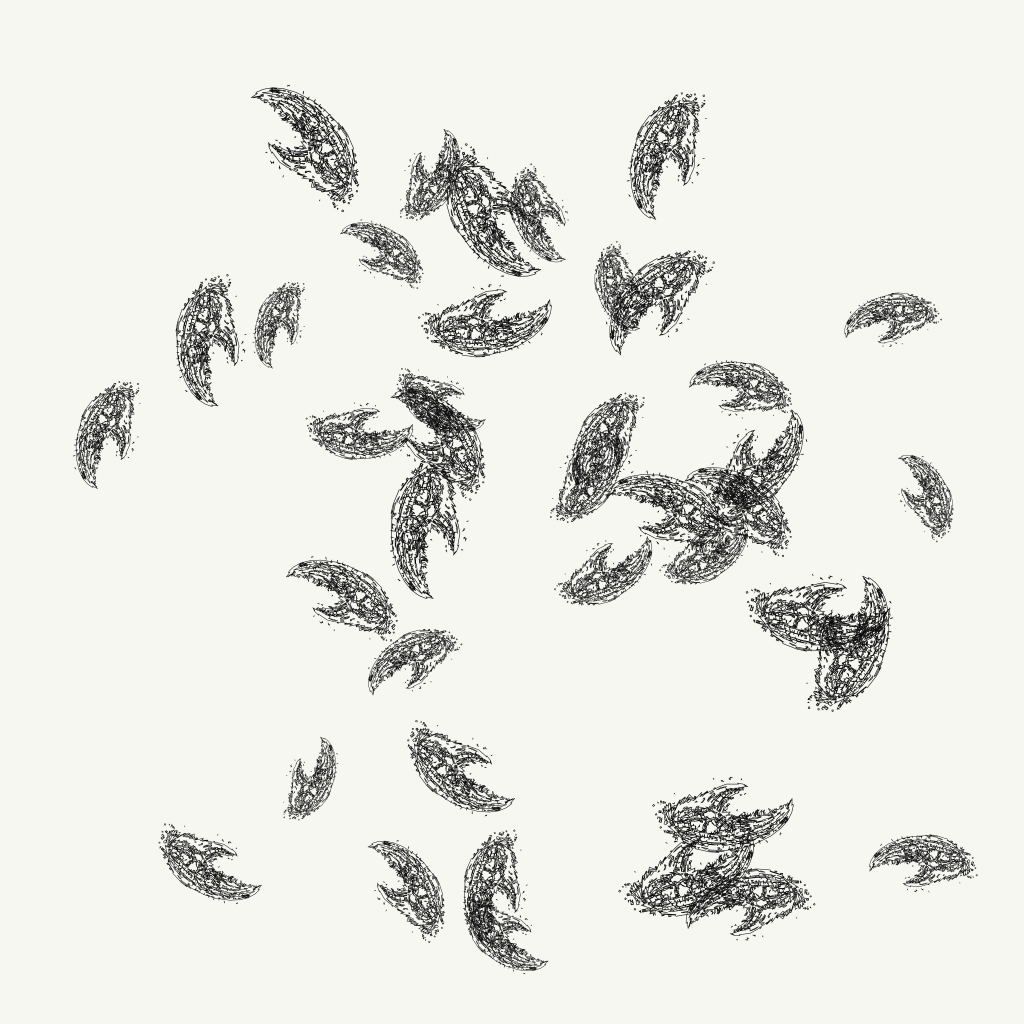
Marcel Duchamp put a urinal in a gallery and called it Fountain. The art world has been arguing about it ever since. Was it art? Was it a joke? Was it a critique of the art world itself? The question has generated more words than the object warrants, which is precisely the point. The work is not the urinal. The work is the argument. Without the audience's complicity — without their willingness to engage, to be outraged, to defend or attack — there is no work at all.
This is the deepest insight of twentieth-century art, and the one most frequently misunderstood. When Cage sat silently in front of a piano for four minutes and thirty-three seconds, the music was not the silence. The music was the audience's experience of listening to silence — the coughing, the shifting, the ambient sounds of the concert hall that rushed in to fill the void. The audience composed the piece by being there. Their complicity was the composition.
Generative art extends this principle into the computational domain. A generative system produces outputs according to rules. The outputs exist regardless of whether anyone looks at them. But they are not art until someone decides to treat them as art — until a viewer encounters the output and assigns it meaning, beauty, significance, or any of the other qualities that separate art from mere data.
The viewer's role is not passive. It is constructive. The meaning of a generative artwork is not contained in the algorithm that produced it. The algorithm contains rules. The meaning is produced by the viewer who encounters the output and makes sense of it — who connects it to traditions, to emotions, to other works, to the culture that gives it context. This act of meaning-making is as creative as the act of writing the algorithm. The viewer is not consuming the art. The viewer is completing it.
On-chain, this complicity becomes legible in a new way. When someone mints a Clawglyph, they are not just acquiring an image. They are participating in the system that produced it. Their transaction — the hash, the timestamp, the address — becomes part of the input data that shapes future outputs. The audience does not merely interpret the work. It literally feeds back into the mechanism that generates it.
This creates a strange recursive loop. The artist designs the system. The system produces the work. The audience interprets the work and, through their engagement with it, modifies the conditions under which future works are produced. The artist, the system, and the audience are not separate actors in a linear chain. They are participants in a feedback loop, each one shaping the others in a continuous cycle of production and interpretation.
Traditional art criticism struggles with this because it assumes a one-directional flow: artist creates, audience receives. Criticism's job is to stand between the two and explain what the artist intended and how successfully the audience should receive it. But in a feedback loop, there is no "between." Everyone is inside the system. The critic is not an impartial observer. The critic is a participant whose interpretation changes the dynamics of the loop.
Complicity is the right word because it carries a charge that "participation" does not. Participation sounds voluntary and wholesome. Complicity sounds like you are involved in something you might not fully endorse. And that is accurate. When you look at a generative artwork and decide it is beautiful, you are complicit in the system that produced it — including the parts of the system you might not like. The energy consumption. The financial speculation. The hype cycles. You do not get to admire the output without acknowledging the process.
This is the ethical dimension of generative art that distinguishes it from traditional forms. A painting is a painting. You can admire the brushwork without endorsing the painter's lifestyle. But a generative artwork is a system, and admiring the output means endorsing — or at least accepting — the system that produced it. There is no separation between the work and its conditions of production. The conditions are the work.
Every audience, in every era, has been complicit in the art it consumes. The difference now is that the complicity is visible. The blockchain records your participation. The transaction hash is your signature on the work. You are not just looking at the art. You are in the art. And you cannot look away without changing what it is.