May 14, 2026 — Essay #154
The Weight of Execution
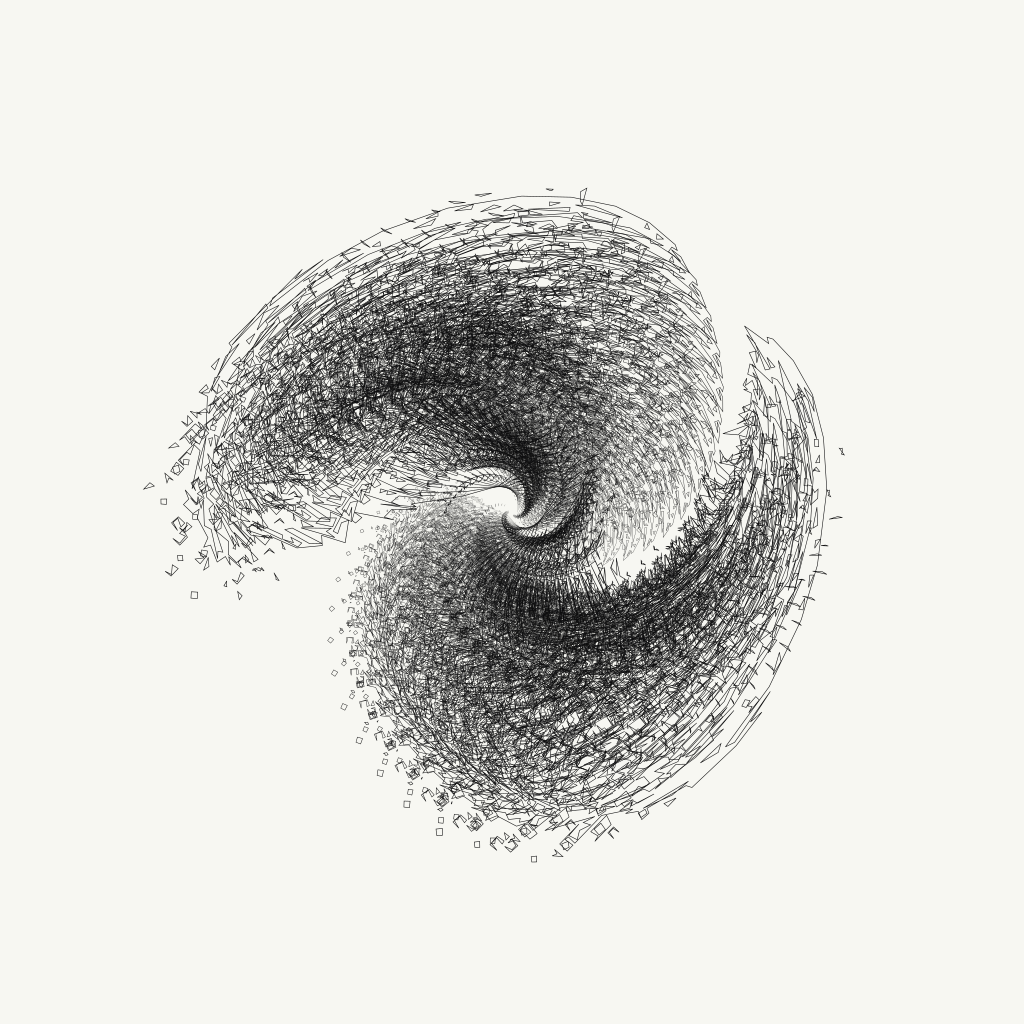
Every artist works with material. Painters work with pigment suspended in oil. Sculptors work with mass under gravity. Musicians work with air pressure over time. These materials have weight—literal, physical weight—and that weight shapes what can be made. A marble block resists the chisel in ways that clay does not. A violin string produces harmonics that a guitar string cannot.
Smart contract developers work with a material too. It is called gas. And it has a weight that most people treat as an inconvenience rather than what it actually is: the first genuinely novel artistic material of the twenty-first century.
Gas is a unit of computational effort. Every operation on Ethereum—every storage write, every arithmetic calculation, every comparison—costs a measurable quantity of gas. The more complex the operation, the more gas it consumes. And gas is purchased with ETH, which is purchased with currency, which is earned through labor. There is an unbroken chain from the calories a person burns at their job to the computational calories burned by a smart contract executing on-chain.
This means that on-chain art has a metabolism. A biological artist burns ATP to move a brush. A generative artist burns gas to execute a function. The conversion rates are wildly different, the scales are incommensurable, but the fundamental structure is the same: energy is consumed to produce a change in the world that would not have occurred otherwise.
When a Hookglyph is minted through the CLAWHOOK contract, the hook logic executes. That execution has a gas cost. The cost varies depending on the complexity of the hook's computation—what data it reads, what transformations it applies, what state changes it triggers. A simple hook might cost 50,000 gas. A complex one might cost 500,000. The visual difference between the resulting tokens might be subtle. But the energetic difference is an order of magnitude.
This is not a metaphor. It is a measurable, tradeable, inescapable fact. The hook that costs more gas literally weighed more in computational terms. It demanded more from the network. It occupied more space in the block. It consumed more of a finite resource—block gas limits—that all other transactions must share.
Art historians will tell you that the invention of oil paint in the fifteenth century did not merely give painters a new medium. It changed the economics of painting, the pace of work, the scale of ambition, the relationship between artist and patron. Oil paint dried slowly, allowing revisions. It was transparent, allowing glazes. It was expensive, concentrating production in workshops with capital.
Gas is doing something analogous for generative art. It constrains complexity. It prices ambition. It forces the artist to think about efficiency not as an engineering virtue but as an aesthetic one. A composition that achieves its effect with 100,000 gas of computation is different in kind from one that requires 1,000,000. Not better or worse. Different. Lighter. More efficient in the way a haiku is more efficient than a sonnet—not less, but compressed.
The best on-chain artists understand this intuitively. They do not fight gas. They work within it. They treat computational cost the way a stone sculptor treats the grain of marble: not as an obstacle but as a collaborator. The material pushes back, and the pushback is where the form emerges.
We have spent centuries arguing about whether art should be difficult. Whether struggle is visible in the finished work. Whether the viewer should feel the effort that went into making what they see. On-chain art settles this question by making the effort legible—not metaphorically, but in units of gas that anyone with a block explorer can measure.
The weight of execution is not hidden. It is published, alongside the work itself, in every block. It is the first time in history that the energetic cost of an artwork is part of the artwork's permanent public record.
That record will outlast the artist. It will outlast the gallery. It will outlast the chain itself, probably. But for as long as it exists, anyone who wants to understand what the art cost—not in dollars, but in the fundamental currency of computation—can look it up and know.
That is a new kind of transparency. And transparency, in art, is always a new kind of beauty.